Item Availability Rules
Posting rules for item availability allow you to define the criteria that control the document-independent availability or availability to cover safety stock and minimum stock of your inventory. Using different criteria, your items or lots in inventory will be shown as available or not available in general. You can set up your rules according to different conditions. The following conditions are available here.
- Expired Goods
- Item
- Lot
- Rem. Shelf Time (absolute) (Insert Condition Filter with date formula. For example <=12M)
- Rem. Shelf Time (%) (Condition Filter with operator <,>,= and number 0-100. For example <50)
- Serial No.
Note
When a lot is selected, its percentage remaining shelf life is determined as follows:
Shelf life = "Expiration date - Reference date" / Expiration date formula on item card.
Example: (01.06. - 01.01) / 12M = 6M / 12 M = 1/2 = 50%
The following date is used as reference date:
- Assembly consumption: Due date
- Item availability: Work Date
- Picking: Due date
- Pos. Adjustment, Purchase: Planned Receipt date
- Pos. Adjustment, Journal: posting date
- Pos. Adjustment, Transfer: Receipt date
- Production consumption: due date
- Sales Shipment: planned delivery date
- Outgoing Transfer: Shipment date
Availability rules with action type item availability are used for the document-independent availability calculation. This affects the following places in the system:
- Field Available inventory item (base) in the Inventory Summary
- Fields Availability balance or Inventory in the pages Item availability by period / location
- Available inventory in the Sales Line details
By setting the Exclude from planning indicator, lots or serial numbers that meet the defined criteria can be excluded to cover safety stock and minimum stock. A distinction in this regard is currently not possible.
If the Expired Goods condition is used in a rule, the inventory summary must be updated daily. This update is performed using the task Inventory Summary - Update availability. To see the effect of newly created item availability rules immediately, this task must be processed manually.
Note
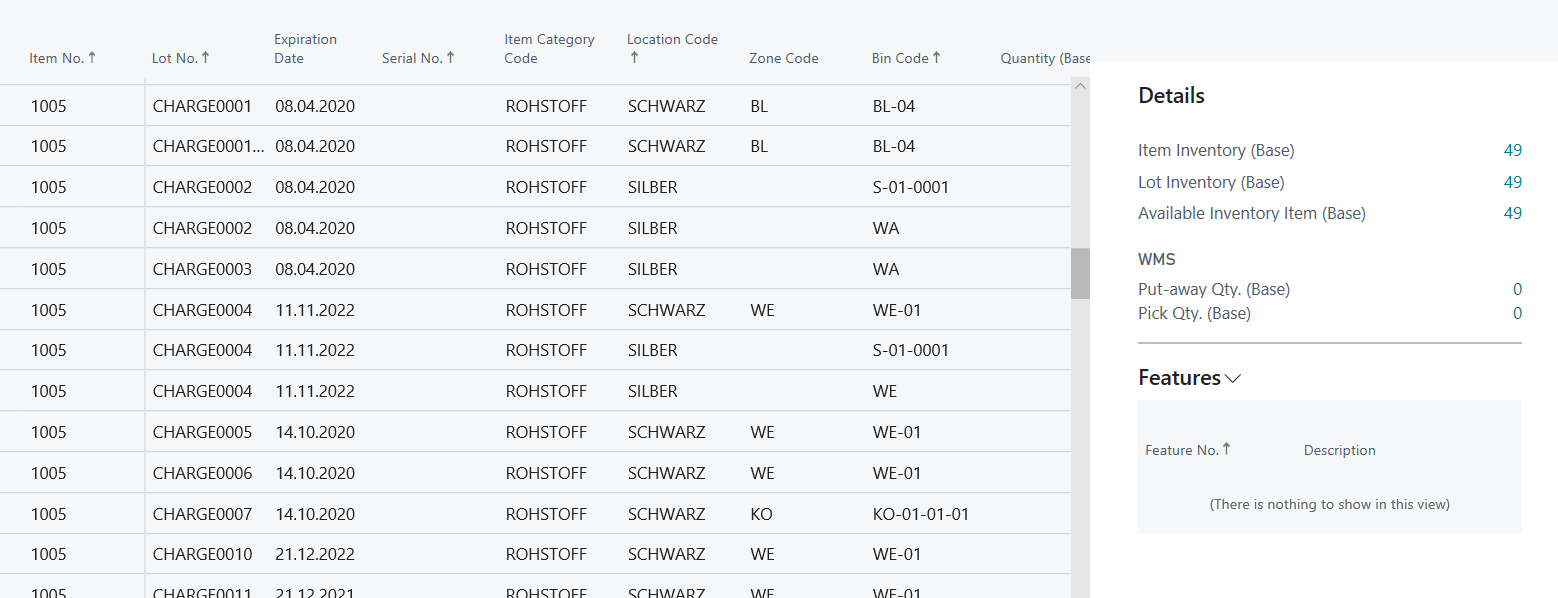
For the availability calculation when creating different documents, e.g. Picking, please set up explicit posting rules. If you set up your posting rule group item availability analogous to your posting rule groups Picking or Sales Delivery, you can, for example, check the actual availability beforehand via your Inventory Summary.
It is possible to combine several conditions within a rule, all of which must apply. In addition, the Priority field can be used to set the order in which your rules are checked. Rules are taken into account starting with the lowest priority, if the field Active is set.
Note
All conditions within a rule must be met for the rule to be applied. This also means, for example, that if the availability calculation is to refer to the status of lots and serial numbers, two rules must be created. One rule that refers to the lot and its status, and a second rule that is for the serial number data.
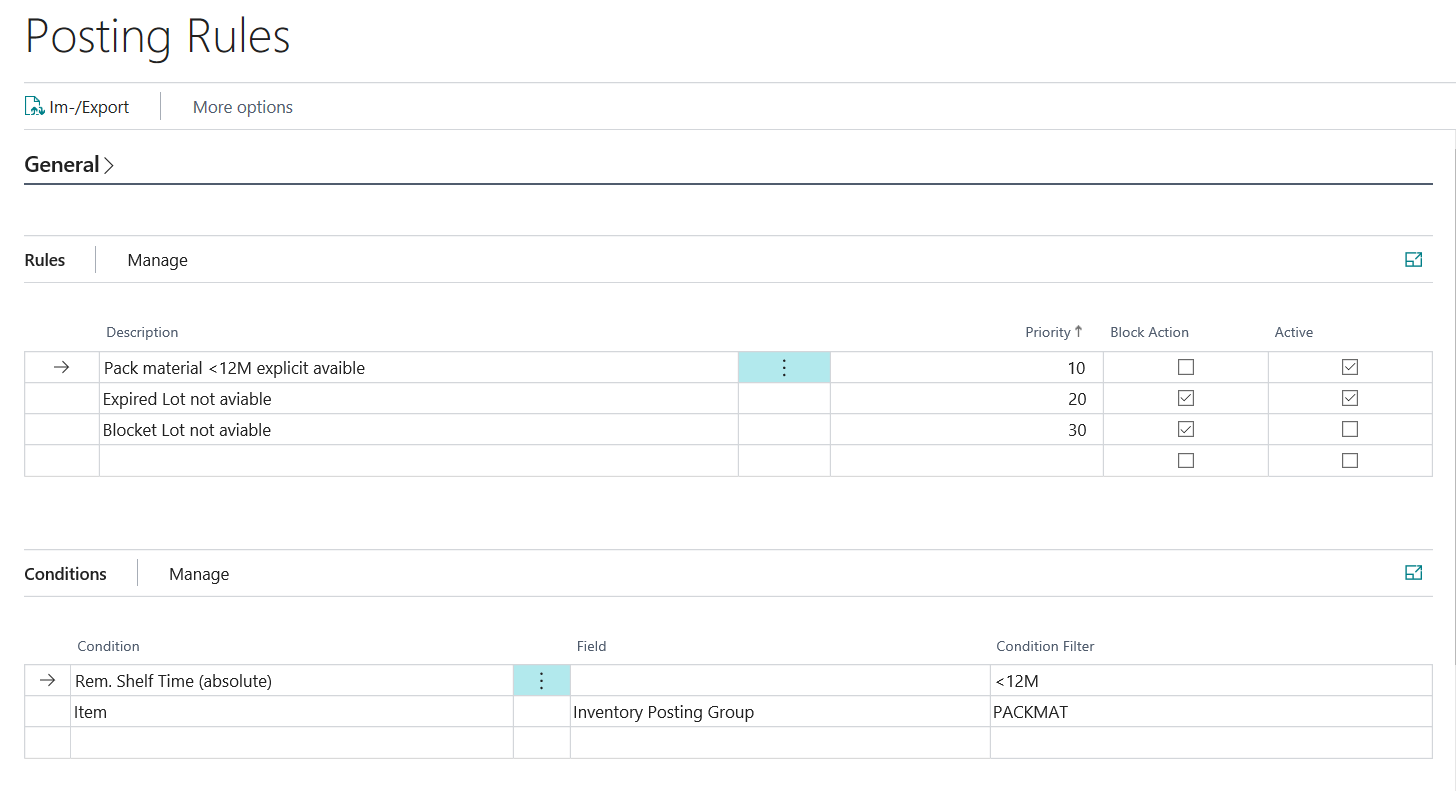
In addition, it is possible to define explicit exceptions. For this, the field Block Action must not be set for an active rule.
Setup example for an explicit exception rule:
- Priority=10: The availability for items with the storage group = PACKMAT is explicitly not restricted if the remaining shelf life of the lot is less than 12 months. This may be the case if the packaging material is not critical to your production or sales process.
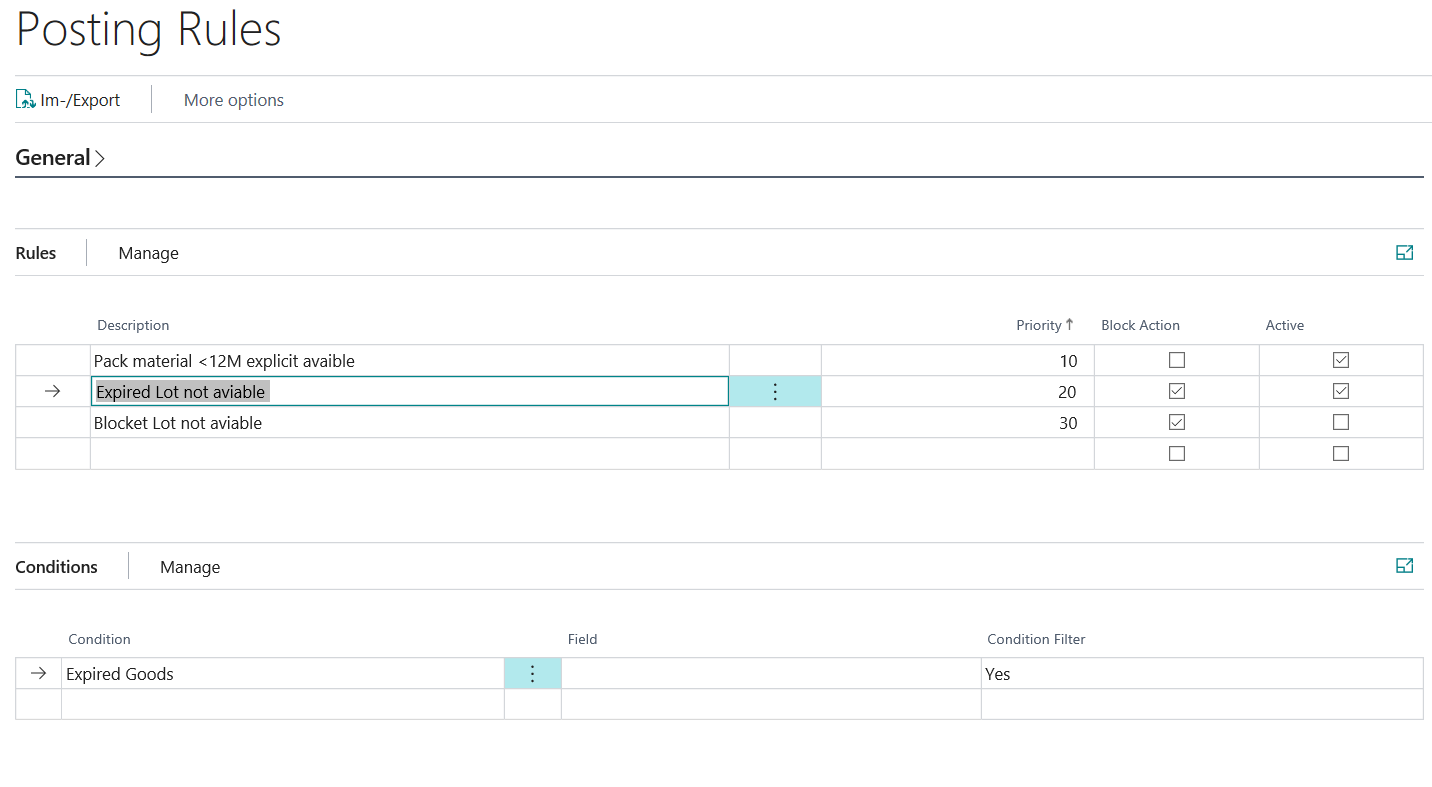
- Priority=20: If a lot = Expired this is no longer included in the general availability calculation.
Note
In the YAVEON feature management, it is possible to activate the Performance-Optimized Rules Check for Availability Calculation feature. This feature optimizes performance within Business Central when availability rules are checked, e.g. during the creation of sales lines. The optimization is particularly effective for companies in which there is a large number of lots for an item. The only tradeoff is that during some transactions the availability of an item is buffered for a maximum of a minute to reduce the amount of calculations during a single transaction. The feature will be extended with further performance improvements in the future.