Positive Adjustment Rules
Posting rules allow you to control the criteria according to which your positive adjustment postings are allowed or prevented.
The positive adjustment posting can be performed
- via Worksheet (even Reclassification Worksheet or Whse. Reclassification Worksheet)
- via Purchase Order (or follow-on documents such as posting the warehouse receipt or creating and registering the put-away) or
- through Physical Inventory
- in a Warehouse Movement that has been created via Replenishment Wksh. or
- Inventory Movements
You can set up your rules according to different conditions. The following conditions are available here:
- Location Code
- Zone Code
- Bin Code
- Expired Goods
- Item
- Lot
- Posted by User Group
- Posted by User ID
- Rem. Shelf Time (absolute) (Insert Condition Filter with date formula. For example <=12M)
- Rem. Shelf Time (%) (Condition Filter with operator <,>,= and number 0-100. For example <50)
- Serial No.
Note
From version BC22 upwards, user groups are replaced by Yaveon User Groups.
Note
When a lot is selected, its percentage remaining shelf life is determined as follows:
Shelf life = "Expiration date - Reference date" / Expiration date formula on item card.
Example: (01.06. - 01.01) / 12M = 6M / 12 M = 1/2 = 50%
The following date is used as reference date:
- Assembly consumption: Due date
- Item availability: Work Date
- Picking: Due date
- Pos. Adjustment, Purchase: Planned Receipt date
- Pos. Adjustment, Journal: posting date
- Pos. Adjustment, Transfer: Receipt date
- Production consumption: due date
- Sales Shipment: planned delivery date
- Outgoing Transfer: Shipment date
It is possible to combine several conditions within a rule, that all must apply. In addition, the Priority field can be used to set the order in which your rules are checked. Rules are taken into account starting with the lowest priority, if the field Active is set.
Note
All conditions within a rule must be met for the rule to be applied. This also means, for example, that if the availability calculation is to refer to the status of lots and serial numbers, two rules must be created. One rule that refers to the lot and its status, and a second rule that is for the serial number data.
In addition, it is possible to define explicit exceptions. For this, the field Block Action must not be set for an active rule.
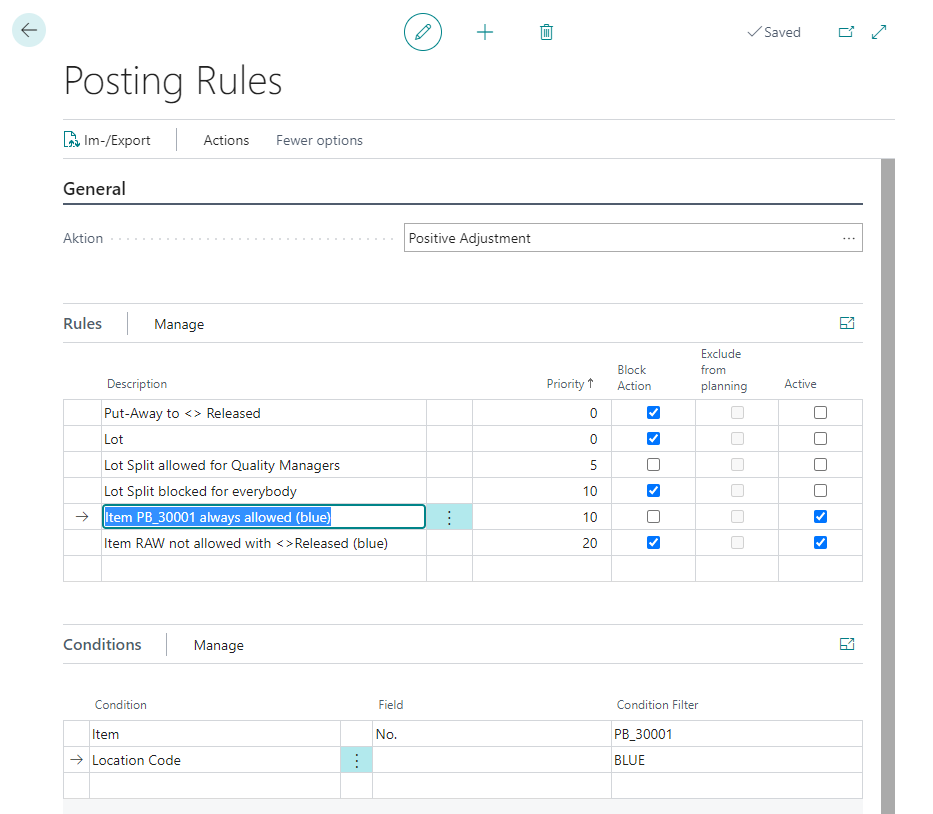
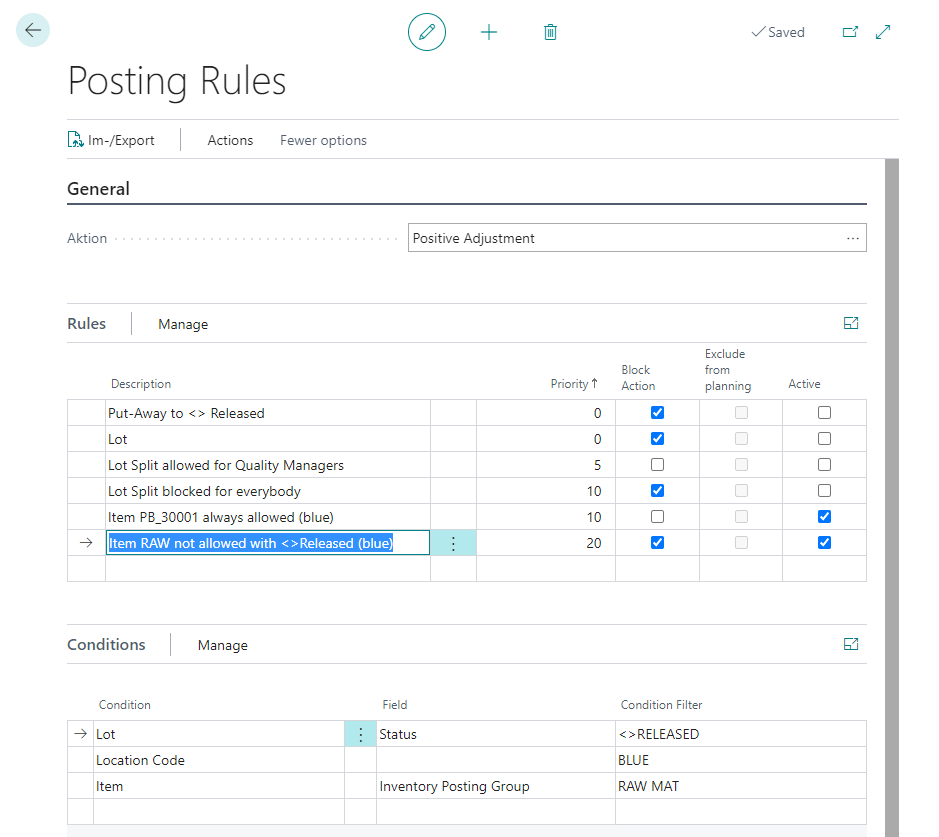
Setup example for an explicit exception rule:
- Priority=10: The positive adjustment posting of the article with the number = PB_30001 and the product posting group = ROHMAT on the storage location = Blau is explicitly permitted by the rule and is not subject to any restrictions.
- Priority=20: The positive adjustment postings of articles with the product posting group = ROHMAT and a lot status <> Approved is not allowed for the storage location = BLAU.
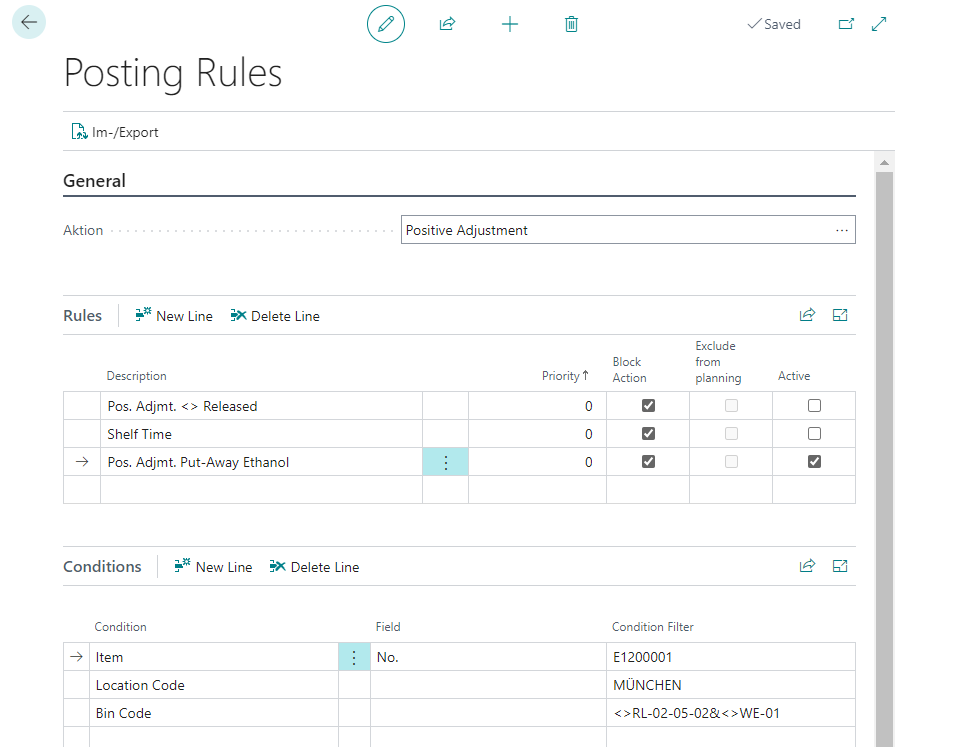
Setup Example for Positive Adjustment of "Ethanol"
In the following example, it is defined that the item E1200001, which is ethanol, may only be stored in a specific, designated bin RL-02-05-02. In addition, an incoming goods bin is permitted to enable delivery. If a storage bin other than those defined here is specified in a warehouse receipt or putaway, an error message appears.